If you work at one of the tech campuses along North Austin’s US-183 corridor or in the offices near The Domain, you probably spend most of your day sitting in front of a monitor. Posture problems do not usually announce themselves with a dramatic injury. They show up gradually, in small signals that are easy to dismiss until they are not.
Recognizing those early signals matters. The sooner you notice a posture shift, the easier it is to correct before it becomes a structural pattern your body has to work around every day.
Why North Austin’s Desk Workforce Is Especially at Risk
North Austin has one of the highest concentrations of tech employees in the city, and that means long hours in front of dual monitors, laptops on standing desks that are not actually set up correctly, and marathon meeting days with little movement in between. Add a commute that often involves more sitting in traffic on MoPac or 183, and the average workday can mean ten or more hours in a seated position.
The human spine simply was not built for that much sustained loading in one position. Over time, certain muscles get chronically tight while others get chronically weak, and that imbalance is what eventually pulls your posture out of alignment.
The Early Warning Signs
Your Head Feels Heavy by Mid-Afternoon
If your neck and upper shoulders feel fatigued or achy by 2 or 3 p.m. most days, that is often a sign of forward head posture. When your head drifts forward off center, even by an inch or two, the muscles at the base of your skull and across your upper trapezius have to work much harder to hold it up. That extra workload shows up as fatigue before it shows up as pain.
You Notice Uneven Shoulder Height in the Mirror
Take a look at yourself in a mirror straight on. If one shoulder consistently sits higher than the other, that can point to muscular imbalance from favoring one side, such as always carrying a laptop bag or mousing with the same arm for hours at a time.
Tension Headaches Are Becoming a Weekly Pattern
A headache that starts at the base of the skull and wraps toward the temples is frequently tied to tight suboccipital muscles and upper cervical joint restriction, both common outcomes of prolonged screen time. If you can link your headaches to your busiest desk days, posture is worth investigating.
Your Lower Back Aches When You Stand Up
If you feel stiff or achy in your low back the moment you stand after sitting for a while, your lumbar spine may be losing its natural curve while you sit, especially if your chair lacks proper lumbar support or you tend to slouch as the day goes on.
You Catch Yourself Rounding Forward Toward the Screen
Rounded shoulders and a forward-leaning torso, sometimes called a “tech hunch,” compress the chest muscles and stretch out the muscles between your shoulder blades. This imbalance makes it progressively harder to sit up straight even when you consciously try.
What Is Actually Happening in Your Spine
Posture problems are not just a cosmetic issue. When your spine sits outside its natural alignment for hours every day, the joints between vertebrae can lose their normal range of motion, a change often described as restricted joint mobility. Nerves that exit between those vertebrae can become irritated by the surrounding tension and misalignment, which is part of why posture strain and nerve-related symptoms like tingling or radiating discomfort often show up together.
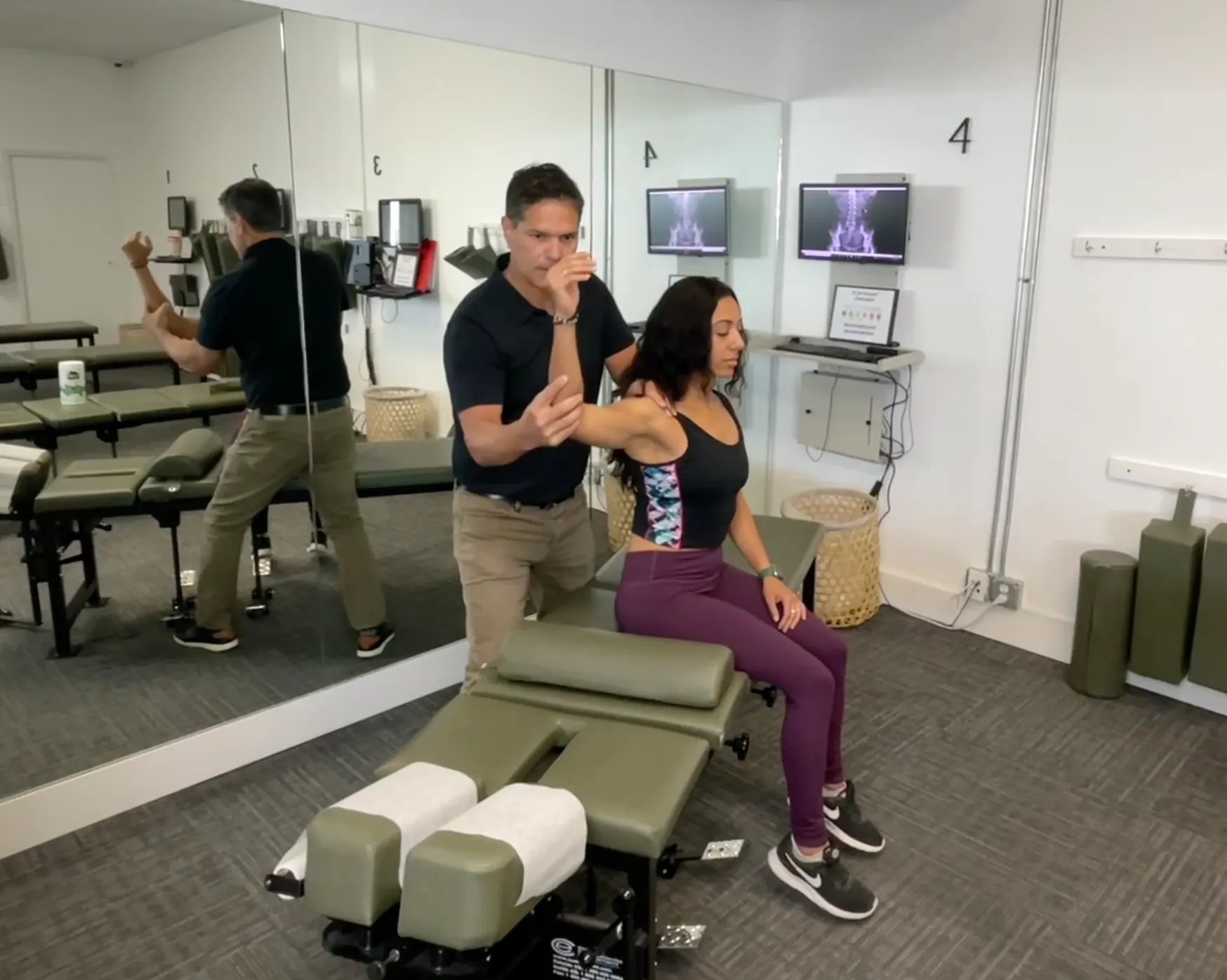
This is where chiropractic adjustments come in. A structural evaluation can identify exactly which segments of your spine have lost mobility and are contributing to your posture pattern, then use targeted, controlled adjustments to restore proper movement to those joints.
Simple Changes You Can Make Today
- Set a recurring reminder every 45 to 60 minutes to stand, stretch, and reset your posture
- Position your monitor so the top of the screen is at eye level, not angled down
- Keep your feet flat on the floor with your hips slightly higher than your knees
- Do a few chin tucks and shoulder blade squeezes between meetings
These habits help, but they work best alongside a professional evaluation of the poor posture patterns that have already developed. Habits alone cannot correct a joint that has already lost its normal mobility.
When to Get It Checked
If you are noticing two or more of the warning signs above on a regular basis, it is worth having your spine evaluated rather than waiting for the discomfort to become constant. Posture-related strain tends to compound: the longer a misalignment sits uncorrected, the more the surrounding muscles adapt to compensate, which can make the eventual correction take longer.
At Espinoza Chiropractic, we see this pattern often in patients from the North Austin tech and office corridor, and many find that regular adjustments combined with small ergonomic changes make a real difference in how they feel by the end of the workday.
References
- National Institute of Neurological Disorders and Stroke, Back Pain Information, ninds.nih.gov
- American Chiropractic Association, Ergonomics and Workplace Wellness, acatoday.org
Take the Next Step
Do not wait until posture strain turns into chronic pain. Espinoza Chiropractic’s North Austin location at 1929 Payton Gin Rd is a short drive from The Domain and the 183 tech corridor. New patients can take advantage of our a $97 first visit (a $297 value) to get a full spinal evaluation and start correcting the problem at its source.
Call us at (512) 488-0786 or book your appointment online today.