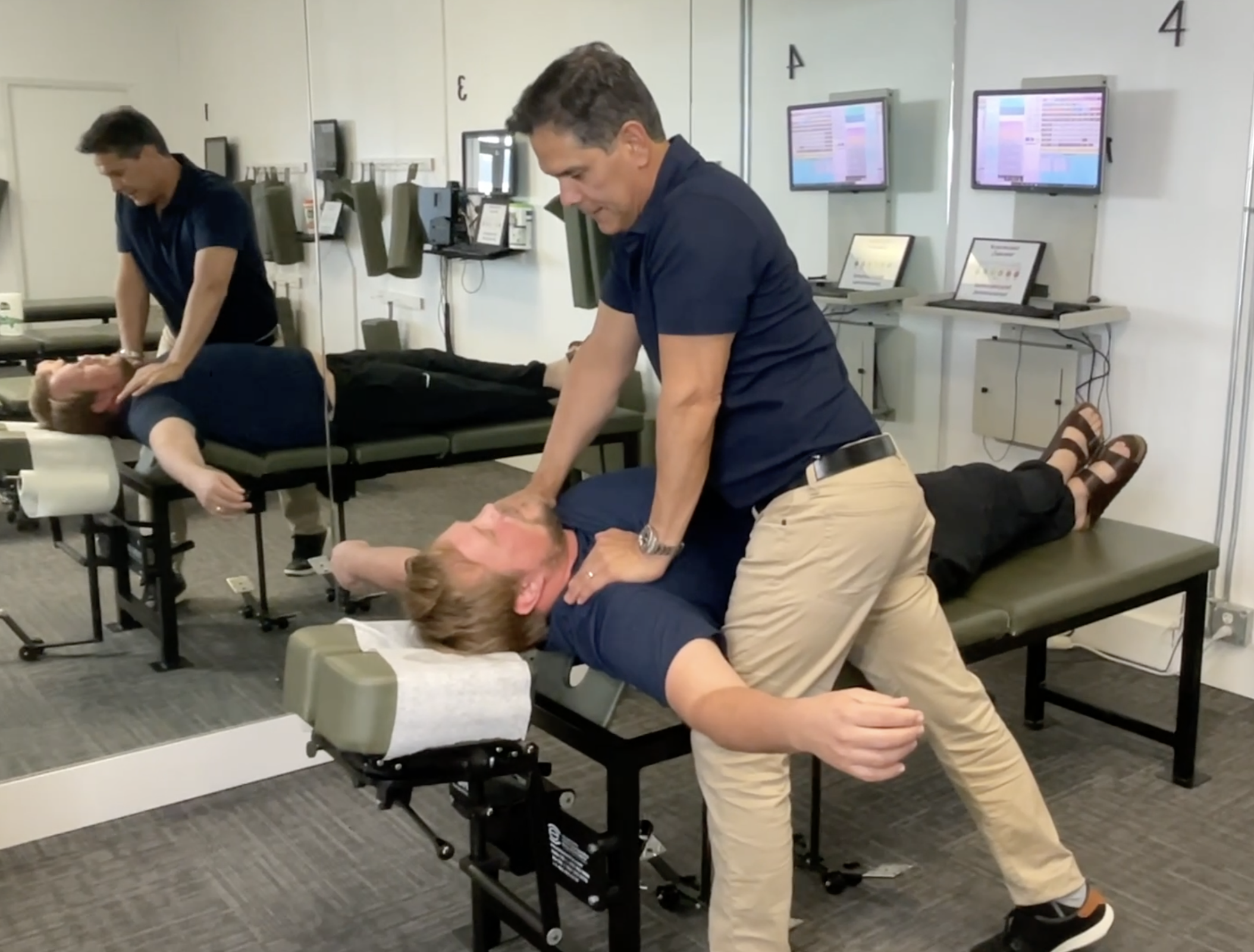
A herniated disc is one of the most misunderstood injuries we discuss with patients. The name sounds alarming, and the internet does not help, but understanding what is actually happening in your spine makes the path to recovery much clearer.
What a Herniated Disc Actually Is
Your spine’s vertebrae are cushioned by discs made of a tough outer ring and a softer, gel-like center. A herniated disc occurs when that outer ring weakens or tears, allowing some of the inner material to push outward. If it pushes against a nearby nerve root, it can cause pain, numbness, or weakness that radiates away from the spine.
Herniated discs often happen suddenly — during a heavy lift, an awkward twist while picking something up, or a sudden strain — but they can also develop gradually from repeated poor lifting mechanics over months or years, which is why the “sudden” injury is often really the final straw on a disc that was already weakened.
What the Symptoms Actually Feel Like
- A sharp, sudden pain at the moment of injury, sometimes described as a “pop” or “give” in the back
- Pain that is worse with sitting, bending, or coughing, and often eases somewhat when lying down
- Numbness, tingling, or weakness that radiates into a hip, buttock, or leg if the disc is pressing on a nerve root
- Muscle spasm in the lower back that makes it difficult to stand up straight
If the herniation is affecting the sciatic nerve specifically, the symptoms often overlap closely with sciatica, since a herniated disc is one of the most common underlying causes of that condition.
What to Do Immediately After a Lifting Injury
- Stop the activity and avoid further lifting or twisting
- Alternate short periods of rest with gentle walking — complete bed rest actually slows recovery for most disc injuries
- Apply ice for the first 48 to 72 hours to reduce inflammation
- Avoid any movement that reproduces sharp, radiating pain
How Chiropractic Care Supports Recovery
The large majority of herniated discs improve with conservative, non-surgical care rather than requiring surgical intervention. Chiropractic treatment focuses on relieving pressure on the affected nerve, improving mobility in the surrounding joints, and supporting the body’s natural healing process through gentle, targeted techniques appropriate for the specific location and severity of the herniation.
Our back pain treatment approach starts with a thorough evaluation to understand exactly where and how severely the disc is affected before recommending a treatment plan, since not every herniation should be treated the same way.
When to Seek Care Right Away
Most herniated disc symptoms respond well to conservative care, but certain signs warrant prompt attention: progressive weakness in a leg, loss of bladder or bowel control, or numbness in the groin area. These are rare but require immediate medical evaluation rather than chiropractic care alone.
For the more common pattern of pain and radiating discomfort after a lifting strain, earlier evaluation generally means a faster, smoother recovery.
New patients can get their first visit for $97 (a $297 value) that includes a full evaluation. Claim the offer or book an appointment at our North or South Austin office if you suspect a disc injury.
References:
- National Institute of Neurological Disorders and Stroke, herniated disc information — ninds.nih.gov
- American Association of Neurological Surgeons, herniated disc overview — aans.org