If you work at a desk in Austin’s tech and office corridors, there is a good chance a headache has interrupted your afternoon more than once this month. Patients frequently describe it the same way: it starts as a dull ache at the base of the skull or across the temples, usually a few hours into a heavy screen day, and gets worse the longer they stay at their desk.
What many people do not realize is that this pattern is rarely about the eyes alone. It is very often a neck problem wearing a headache disguise.
The Neck-Headache Connection
The top three vertebrae in your neck share nerve pathways with the areas of your head and face where tension headaches are typically felt. When the muscles and joints of the upper neck become tight or restricted — which happens easily with hours of forward head posture at a screen — those same nerve pathways can refer pain up into the head. This is known as a cervicogenic headache, and it is extremely common among people who spend the majority of their day looking at monitors.
Screen fatigue compounds the problem. Staring at a screen reduces your natural blink rate, which strains the eyes, and most people unconsciously lean their head and shoulders forward as focus intensifies, tightening the exact muscles connected to headache-prone nerve pathways.
Why It Is So Common in Austin’s Workforce
Austin’s concentration of tech, software, and knowledge-work jobs means a large share of the workforce spends eight or more hours a day in front of a screen, often across multiple monitors that require repeated head turning. Combine that with long commutes on I-35 or MoPac, where the neck is held in a fixed position again, and the cumulative strain adds up fast.
This pattern connects directly to the headaches and migraines we regularly evaluate in patients whose primary complaint sounds like a headache problem but traces back to neck mechanics.
What Actually Helps
Fix the Setup First
Raise your monitor to eye level, sit close enough that you are not craning forward, and take a real break from the screen every 30 to 45 minutes, even if it is just looking at something 20 feet away for 20 seconds.
Loosen the Upper Neck Regularly
- Chin tucks: pull the chin straight back, hold five seconds, ten reps, several times a day
- Upper trap stretch: gently tilt your ear toward your shoulder until you feel a stretch along the side of your neck, hold 20 to 30 seconds each side
- Shoulder blade squeezes: pull the shoulder blades back and down, hold five seconds, ten reps
Address the Joint Restriction Directly
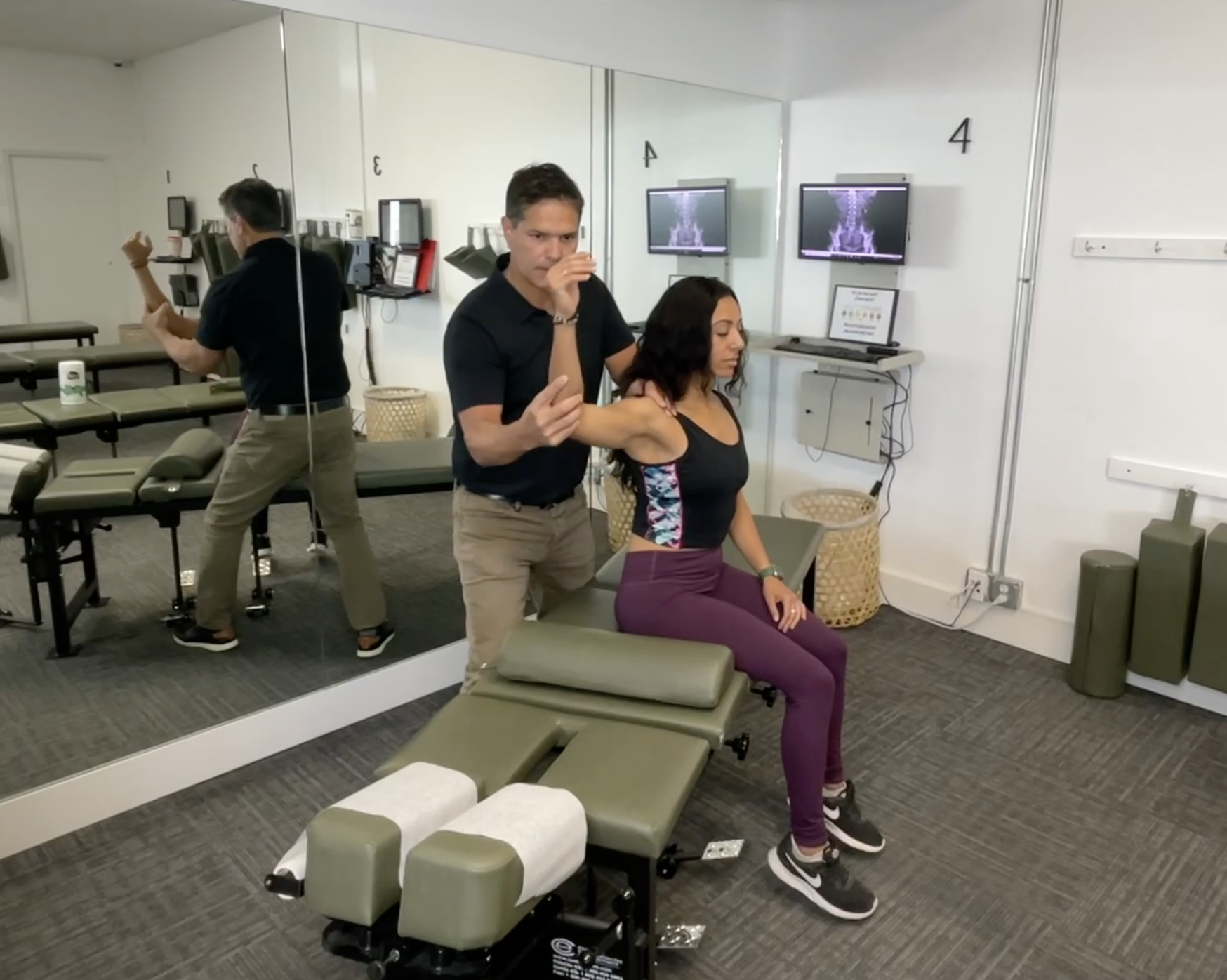
Stretching relaxes muscle, but it does not correct a stiff or misaligned joint in the upper neck. When headaches are frequent or predictable — tied to long screen days, for example — that is usually a sign the joint restriction needs direct attention rather than just muscle relief.
Our headache and migraine treatment approach targets the upper cervical spine specifically, which is where this type of desk-driven headache most often originates.
When to Get Evaluated
If you are getting headaches more than once a week, if they consistently start with neck tightness, or if over-the-counter medication is becoming a daily habit, it is worth having your neck evaluated rather than just treating the headache symptom repeatedly.
New patients can get their first visit for $97 (a $297 value) right now, which includes a full evaluation to identify whether your headaches are coming from your neck. Claim the offer or book an appointment at our North or South Austin office.
References:
- National Institute of Neurological Disorders and Stroke, headache information — ninds.nih.gov
- American Chiropractic Association, cervicogenic headache overview — acatoday.org